
Florida squeezes more than 1,100 golf courses onto one sun-lit peninsula—the highest density in the United States.
When you hunt for a fairway address, one decision drives everything: will golf be bundled into your home price, or will you buy an equity stake to claim a tee time?
Over the next few minutes, we’ll unpack those models, spotlight communities that excel at each, and reveal the 2026 price tags behind the scorecards. Pour a coffee and let’s streamline your search.
Your membership options, decoded
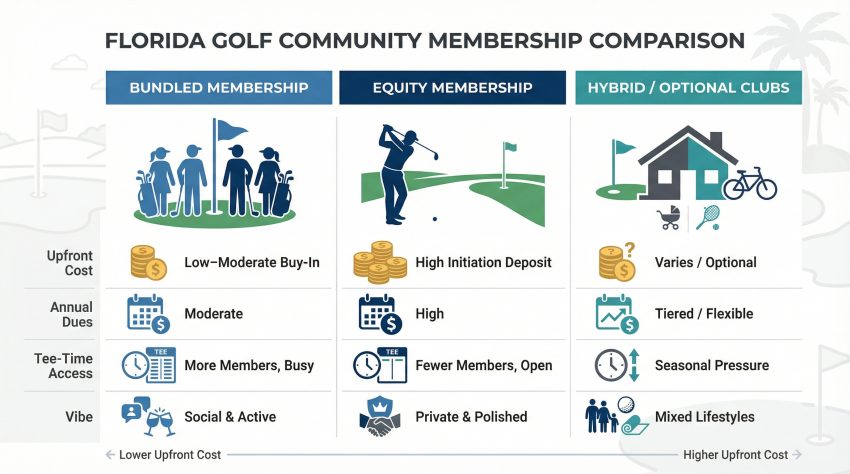
Bundled membership: golf included, crowds included
Picture closing on a condo and teeing off the next morning with zero paperwork.
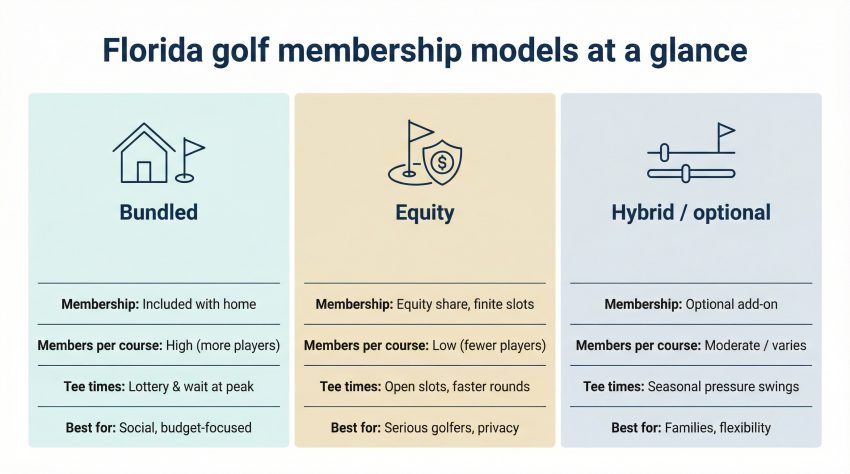
That promise defines a bundled golf community. Your deed and your member card arrive together: buy the real estate, become a full club member on day one. The club price is folded into the home, so there is no separate initiation fee or equity deposit. According to the Heritage Bay membership page, “you are automatically a member… no equity or deposits required.”
Annual dues still apply, typically 5,000 to 10,000 dollars per year, and they fund course upkeep, clubhouse staff, and Friday-night shrimp boils. According to Golf Life Navigators’ 2025 survey, that range holds true statewide. To ground those statewide estimates, we pulled the February 2026 feed from SquareFoot Homes, which tracks every active golf-community listing statewide. A quick scan shows bundled two-bed condos as low as $70,000 and estate homes well past $3 million. Readers can browse available homes in the same feed and sort by county, price, or HOA fees to decide whether the bundled model really pencils out for their budget. Their 2026 Naples and Sarasota data pin the median golf-dues line at about $7,800, right in the middle of that band. The firm’s quarterly Florida Golf Living Report breaks dues down by county and condo size, giving shoppers a cheat sheet when they compare communities online. Because every homeowner carries a bag tag, the roster grows quickly. A single 18-hole track can serve 600, sometimes 700 players. Peak-season mornings fill fast, so bundled clubs use lottery tee sheets and gentle peer pressure to keep foursomes moving.
What you lose in exclusivity, you gain in energy. Step into the grill room and you meet an instant social circle: neighbors, league captains, and snowbirds trading fishing tips. Bundled neighborhoods skew active and inclusive; pickleball courts stay lit well after sunset, and new owners join weekly scrambles before their boxes are unpacked.
Who thrives here? Golfers who want frequent play over private fairways, couples who like predictable budgets instead of six-figure buy-ins, and anyone eager for a ready-made community. If that sounds right, keep reading as we compare this model with equity clubs and flag the Florida enclaves that run each style well.
Equity membership: fewer players, steeper entry fee
Equity clubs flip the bundled script.
Instead of folding golf into the HOA, they sell a finite number of shares, usually 250 to 350 per 18 holes, according to Golf Life Navigators’ 2025 data. When you buy that share, you become an owner, not just a guest with playing privileges.
The up-front check is serious. Six-figure initiation deposits are common, and part of that sum is refundable equity once you resign. Annual dues then keep the lights on, often 15,000 to 30,000 dollars per year, reports the 2025 private-club study by Nalu Magazine. The math feels heavy until you open a tee sheet that still shows slots on a blue-sky Saturday in February. Fewer members mean faster rounds, flawless turf, and staff who greet you by name.
Ownership changes the mood. Members vote on capital projects, track reserve funds, and guard tradition like a well-read rule book. That governance pays off in consistency: courses are rebuilt on schedule, chefs arrive from five-star resorts, and junior tee markers stay fresh rather than faded.
Social energy shifts, too. Because not every resident is a golfer, the club becomes a planned destination. You see familiar faces every week, friendships deepen, and league rivalries carry real bragging rights. It feels more like a private business you co-own than an amenity you rent.
Equity shines for golfers who crave wide-open fairways, zero waitlists, and a tangible stake in their playground. If that sense of stewardship speaks to you, keep an eye on the elite communities we will highlight later, where initiation fees rival real-estate prices but the golf experience borders on flawless.
Hybrid and optional clubs: flexibility for modern families
Some communities refuse to fit neatly into either bucket.
You can buy a home first, then decide when—or if—you will join the golf club. Lakewood Ranch near Sarasota is a prime example: three private courses under one banner, separate neighborhoods where golf is bundled, and others where you pay as you go.
This à-la-carte approach suits residents who juggle careers, youth sports, and travel. They value the peace of mind that a full-privilege membership is available, yet enjoy the freedom to postpone that cost until work slows down or the youngest finishes college.
The model changes social dynamics as well. Not every neighbor golfs, so block parties mix pickleball players, boaters headed for the beach, and school-run parents. Variety is the upside, while the downside is seasonal tee-sheet pressure; demand climbs when snowbirds buy short-term upgrades, then eases each summer, according to Golf Life Navigators’ 2025 utilization study.
Hybrid clubs suit buyers who are still gauging how much golf fits into the week. Sign up when you are ready, downgrade if life gets busy, and let broader amenities such as trails, pools, and restaurants carry the load between rounds.
What a Florida golf membership costs in 2026
Sticker shock is real, so let’s pull the bandage quickly.
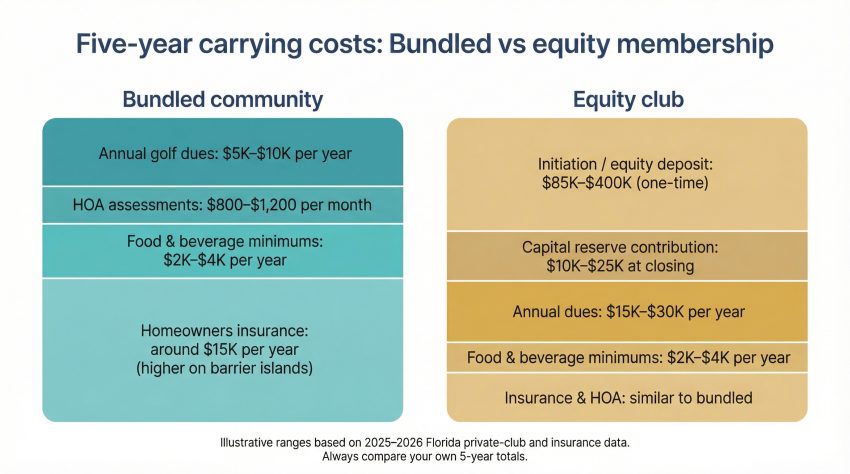
Top-tier private clubs now ask 85,000 to 400,000 dollars just to walk through the locker-room door, and annual dues add 15,000 to 30,000 dollars. Nearly half of Florida’s private clubs run a waitlist, up from one-quarter before the pandemic, according to industry surveys by both Nalu Magazine and Golf Life Navigators.
Bundled neighborhoods look cheaper at first glance, but the math still matters. You skip the initiation fee, yet you write checks for:
- Annual golf dues: 5,000 to 10,000 dollars.
- HOA assessments: condo owners in coastal counties report 800 to 1,200 dollars per month for newer buildings.
- Food-and-beverage minimums: budget 2,000 to 4,000 dollars a year unless you cook every night.
- Rising homeowners insurance: state averages hover near 15,000 dollars per year for a single-family home, higher on barrier islands, per the Insurance Information Institute’s 2025 report.
Equity clubs add two wrinkles. First, a capital reserve contribution many buyers forget—think 10,000 to 25,000 dollars due at closing to shore up long-term projects. Second, that refundable portion of your deposit returns only once a new member replaces you. In coveted enclaves, that is quick; in sleepy summers, patience is required.
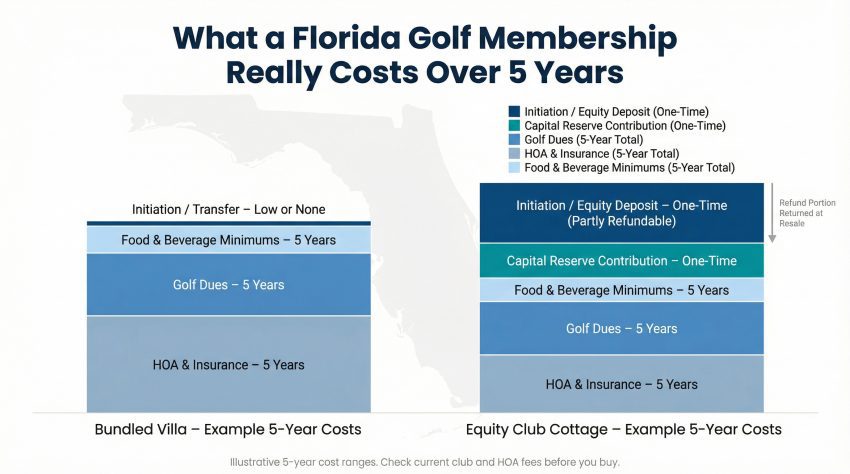
Where does that leave the smart shopper? Compare five-year carrying costs, not just day-one numbers. A bundled villa with higher monthlies can land in the same budget range as an equity cottage once you account for a future refund. Run the spreadsheet, then decide whether you prefer to prepay for privacy or pay as you go for camaraderie.
How we picked Florida’s stand-out communities
Scrolling Zillow is not enough. We wanted clubs that deliver course quality, financial sanity, and day-to-day fun. Here is the lens we used.
First, golf access. We checked the member-to-hole ratio, a fast way to see whether you will spend more time waving or waiting. Anything under twelve golfers per hole scored well. Courses with extra practice space, short-game areas, or tech ranges earned bonus points, following Golf Life Navigators’ 2025 methodology.
Second, membership value. Price alone never tells the story, so we balanced initiation fees, annual dues, and what you receive for the money. Clubs reinvesting in turf, drainage, or clubhouse upgrades leapt ahead of those living on past glory.
Third, lifestyle depth. We looked past the scorecard to see whether families have something to do at 4 pm on a rainy Tuesday. Modern fitness centers, resort pools, pickleball programs, and kids’ camps all mattered. A community that feeds both the eight-handicapper and the eight-year-old rose quickly on the chart.
Fourth, real-estate range. We favored neighborhoods with variety—condos for the snowbird couple, estates for the CEO, and coach homes for the mid-career buyer. Geographic spread counted too; our list touches every coast plus Orlando, so you can weigh Gulf sunsets against Atlantic surf.
Finally, the X-factor. Maybe it is a private airstrip, a Jack Nicklaus academy, or a marina ready for 100-foot yachts. When a place offered something you cannot replicate with a larger clubhouse or fancier menu, it jumped onto the page.
The Bear’s Club – Jupiter, Palm Beach County
Pull into the paver drive and the gatehouse feels more art gallery than checkpoint. Inside, only about 270 golf members roam Jack Nicklaus’s pine-framed masterpiece, so you rarely see more than two carts on a horizon of emerald. The initiation deposit sits around 300,000 dollars, and annual dues mirror a luxury SUV lease, yet every dollar echoes in the silence between tee shots.
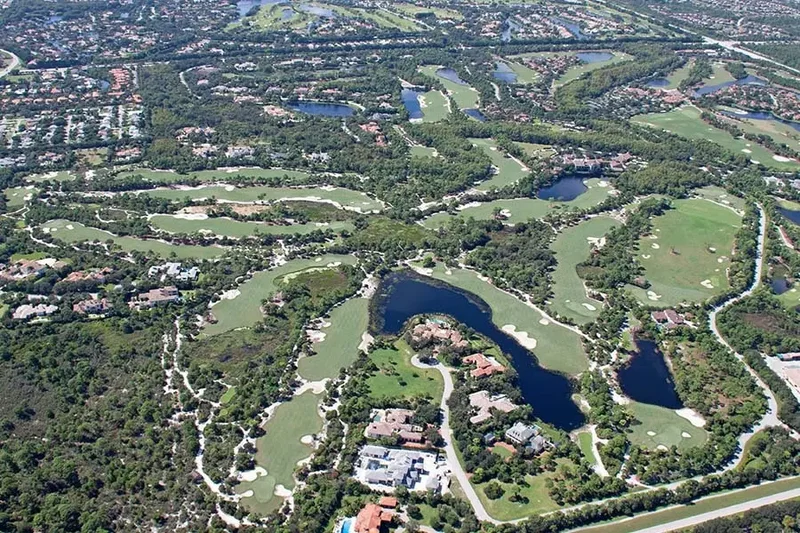
Homes hide behind mature slash pines rather than beside laser-straight fairways. Picture Mediterranean roofs in earth tones, 3-million-dollar villas up to 20-million-dollar compounds with private putting greens. Residents value understatement; you could share a range bay with a major champion and never swap last names.
The 40,000-square-foot clubhouse whispers instead of shouts. White-tablecloth dining flows into a cigar terrace, and the sommelier recalls your preferred vintage by the second visit. There is no water-slide pool or Saturday DJ brunch. The amenity is privacy itself, plus a Nicklaus academy where tour pros fine-tune wedges while you warm up.
Ideal member? The purist who measures luxury by empty fairways and staff who anticipate questions before you ask. If your perfect round ends with quiet conversation, a rare cabernet, and zero Instagram geotags, The Bear’s Club supplies that hush in full.
Grey Oaks Country Club – Naples, Southwest Gulf Coast
Drive ten minutes inland from Naples Pier and Mediterranean rooflines give way to rolling fairways framed by palmettos. Grey Oaks places 54 holes at your doorstep, each with its own personality: Pine is a strategic bruiser, Palm flirts with water on almost every shot, and Estuary winds through quiet nature preserve.
Joining calls for a 250,000-dollar deposit plus annual dues, but that investment buys breathing room. Even in February you can book next-day tee times, thanks to a strict limit of about ten members per hole. Conditioning rivals PGA venues: greens roll at tournament speeds and bunkers receive fresh, Augusta-white sand each spring.
Life off the course feels like a boutique resort. A 63,000-square-foot clubhouse hosts wine dinners one night and art shows the next. Across the street sits the Sports Campus with eight pickleball courts, a resort pool complete with lazy river, and a fitness center where the 6 am spin class often sells out.
Real estate ranges from coach homes around 2 million dollars to estates topping 10 million, all tucked behind preserve buffers. No two streets look identical, yet every driveway is cobblestone and each façade meets a tight architectural review. That polish, paired with downtown Naples minutes away, keeps resale demand strong.
Ideal member? Golf couples who crave variety, enjoy an active social calendar, and prefer country-club luxury seasoned with Florida sunshine.
John’s Island Club – Vero Beach, Treasure Coast
Step past the dunes and you realize John’s Island is less a club than a private micro-county, stretching from the Atlantic surf to the Indian River. Three championship courses anchor the lifestyle: a Pete Dye original framed by oak canopies, a Jack Nicklaus layout flirting with river marshes, and a Tom Fazio routing that feels like a coastal Carolinas import. With 54 holes for roughly 1,400 members, tee sheets stay civil even in high season.
Equity buy-in sits in the mid-six figures, yet members treat it as a legacy purchase. Families pass cottages down like heirloom watches, and that generational rhythm shapes everything: Friday fish fries on the beach, croquet whites crisp at 9 am, and black-tie galas every New Year’s Eve.
Real estate spans shell-stone cottages around 1 million dollars to oceanfront estates topping 15 million. Architecture nods to Old Florida chic with British West Indies shutters, deep verandas, and coral-keystone patios. Strict design rules keep façades timeless; a 1980s courtyard home and a 2020 replacement feel cut from the same cloth.
Ideal member? Multi-generation households who want sand between their toes by breakfast, world-class golf by lunch, and a community that balances tuxedos and flip-flops without blinking. At John’s Island, tradition is not stuffy; it is the beat that keeps the island enclave moving.
The Concession – Bradenton/Sarasota, Gulf Coast
If you dream of a course that bites back, put The Concession on your short list. Jack Nicklaus and Tony Jacklin carved 18 holes across 520 acres of pines, oaks, and wetlands, then kept houses away from fairway edges. No rooftops intrude on your line, and wildlife often outnumbers golfers.
Membership asks about 150,000 dollars to join, plus annual dues, but that check buys what many call the purest test in Florida. The club hosted the 2021 WGC-Workday Championship, where tour pros finished over par. Members relish that edge; practice greens roll in the double digits even during July heat.
Estate homes rest on one-acre lots beside lakes, trading postcard golf views for privacy. Custom builds run 2 million to 6 million dollars, many with glass walls that slide open to lanais facing moss-draped oak hammocks.
Off-course life stays low-key. A 33,000-square-foot clubhouse offers fine dining and a tavern that nods to English heritage. The sports campus adds tennis, pickleball, fitness, and a resort pool, but events remain modest. Most members grind on the range, grab a craft beer, and map tomorrow’s match.
Ideal member? A single-digit handicapper who prefers to walk on, finish in three and a half hours, and debate green-reading lines over Scotch instead of attending themed costume parties. The Concession is golf, distilled.
Lake Nona Golf & Country Club – Orlando, Central Florida
Picture a championship course wrapped inside a Silicon Valley test lab. Tom Fazio’s 7,200-yard routing anchors Lake Nona, but just beyond the pines you will find biotech campuses, 5G corridors, and an autonomous shuttle carrying residents to brunch.
Membership is non-equity: 50,000 to 75,000 dollars to join, with annual dues in the mid-teens. The club caps numbers tightly, so weekday tee sheets often show more open slots than reservations, a ratio that lures PGA and LPGA pros.
Homes lean modern with white stucco, steel accents, and floor-to-ceiling glass. Villas start in the high 1-million-dollar range, while lakefront estates push past 8 million. Every street has gigabit fiber, and Orlando International Airport sits ten minutes away, a perk for business travelers and visiting family.
Amenity life stays active and family-forward. The Bath & Racquet Club hosts sunrise yoga, while kids explore a waterfront adventure park or attend golf clinics run by coaches from local college teams. Friday evenings shift to food-truck rallies at the town center, proof that Lake Nona blends top-100 golf with a neighborhood vibe that feels fresh rather than formal.
Ideal member? Professionals drawn to Orlando’s tech-and-medical corridor, parents chasing A-rated schools, or retirees who prize an airport gate as much as a garden view. Here, smart-home apps and smooth greens live in calm partnership.
Boca West Country Club – Boca Raton, Southeast Florida
Imagine a cruise ship parked on dry land: that is Boca West. Four championship courses—two Arnold Palmer designs, one Jim Fazio, and one Pete Dye—wind through 55 villages and more than 3,400 homes, from two-bedroom condos under 300,000 dollars to lakeside estates above 5 million.
Membership is mandatory and equity based, yet pricing stays below ultra-elite tiers. Plan on about 90,000 dollars to join and roughly 20,000 a year in dues, funding an amenities lineup that borders on resort scale: a 90,000-square-foot clubhouse with seven restaurants, a spa to rival top hotels, 29 tennis courts, 14 pickleball courts, and a pool complex that could headline a Caribbean property.
The social calendar rarely pauses. Monday may feature a women’s nine-hole mixer, Tuesday a sushi class, and Thursday a Broadway-style show in the ballroom. That rhythm draws younger retirees and active families; the average member age now sits in the mid-sixties and falling, according to 2025 enrollment data.
Boca West fits buyers who crave variety. You can play a different course each day, choose a new restaurant each night, and still have energy left for a Friday poolside happy hour. If you equate value with “how much can I do without leaving the gate,” this is paradise in a Boca ZIP code.
Heritage Bay Golf & Country Club – Naples, Southwest Florida
Think of Heritage Bay as the Swiss Army knife of Naples golf living: everything you need, nothing you do not, all at a price that leaves budget room for sunset cocktails on Fifth Avenue. Buy a veranda condo or coach home and your golf membership activates automatically. No initiation fee, no interviews—just pick up your bag tag at the pro shop and join tomorrow’s scramble.
The course lineup features three distinct nines that shuffle into fresh 18-hole combinations each day, giving snowbirds variety without leaving the gate. Annual dues land around 7,000 dollars, and a recent 10-million-dollar clubhouse refresh replaced worn décor with coastal-chic lounges and a poolside cabana bar that hosts live music on Friday evenings.
Social life mirrors the dues: approachable. Residents wave newcomers into foursomes, tennis clinics fill with first-season owners, and the pickleball ladder stretches from sunrise to dusk. Many owners stay only for winter, keeping tee sheets open in summer and fueling a healthy rental market for those who travel.
Homes start in the high 300,000s for condos and climb toward 1 million dollars for single-family models with private pools. Every lanai looks over either water, preserve, or fairway, so morning coffee always comes with a postcard view.
Ideal member? Retirees and mid-career couples who want Naples sunshine, lively amenities, and an easy entry ticket to unlimited golf—without wiring six figures before the first swing.
Lakewood Ranch – Sarasota region, Southwest Florida
Lakewood Ranch is not a single neighborhood; it is a 31,000-acre town stitched together by bike paths, parks, and pocket villages. Here, golf comes in flavors. Live in Lakewood National or Esplanade and membership is bundled into the mortgage. Prefer to play only twice a month? Skip the initiation and pay greens fees at the semi-private Legacy course. Freedom is built into the street grid.
The flagship Lakewood Ranch Golf & Country Club spreads three championship layouts across two campuses, each capped at a member count that still lets you book Saturday times without a spreadsheet. Initiation sits near 40,000 dollars, and annual dues hover in the low five figures.
Real estate spans two-bed coach homes starting in the mid-300,000s to gated estates in The Lake Club that exceed 2 million dollars with Tuscan stonework, wine cellars, and lake panoramas. Every front porch links to trails winding past wetlands and coffee shops.
Lifestyle supplies the exclamation point. Waterside Place, the open-air town center, hosts farmers markets, waterfront restaurants, and concerts under string lights. Kids join soccer on pristine fields; parents meet for barre class before teeing off; retirees kayak placid lakes at sunrise. The vibe feels more hometown than gated enclave, perfect for multigenerational families who view golf as a chapter, not the whole book.
Ideal member? Anyone torn between country-club amenities and suburban convenience. Lakewood Ranch lets you dial golf up or down without uprooting your address or your budget.
The Villages – Central Florida
Welcome to golf’s version of a theme park. Seventy themed neighborhoods connect through 100 miles of golf-cart paths, each lane buzzing toward the next tee or tiki bar. Buy any home—from manufactured cottages near 250,000 dollars to designer models approaching 700,000—and, after paying the monthly amenities fee, you are a member of nearly 60 courses, including more than 40 executive layouts that cost residents zero in greens fees.
Crowding sounds inevitable until you see the scale. Tee sheets flex across so many holes that even January mornings move briskly once the starter whistles. A digital lottery handles peak demand; by your second season you will know which calendar blocks stay wide open.
Life here is kinetic. Three town squares pump out free live music every night. Recreation centers host everything from woodworking guilds to synchronized swimming. Softball leagues fill entire brackets, and pickleball might as well be a civic religion. The demographic skews active—many residents log 10,000 steps before lunch.
The social contract is simple: bring your own fun and you will not wait long for company. Golf is the backbone, but the skeleton includes dance clubs, vintage-car rallies, and surprise line-dancing flash mobs.
Ideal member? Retirees who equate value with volume and view a bustling calendar as the ultimate amenity. If you want solitude on every swing, look elsewhere. If you thrive on motion—and free nine-hole loops before breakfast—The Villages hands you the keys to the cart kingdom.
Rising regions to watch
Florida’s golf spotlight once bounced only between Naples and Palm Beach, but fresh fairways are sprouting elsewhere at friendlier prices.
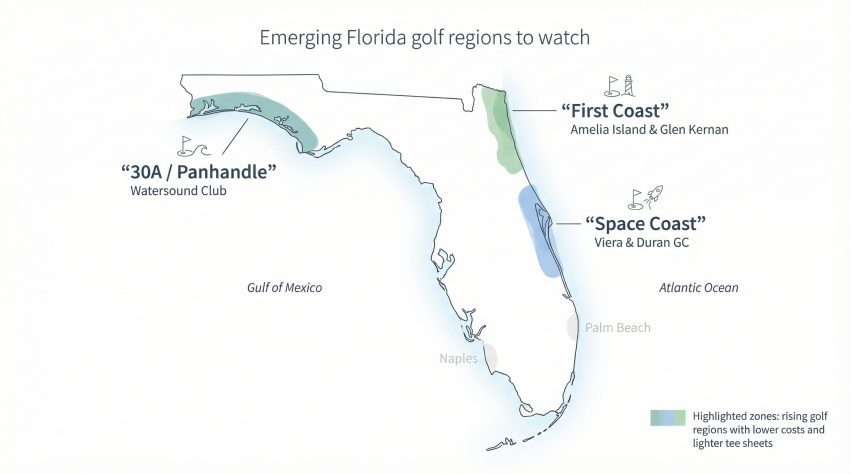
Along the Panhandle’s Highway 30A, the St. Joe Company is blending beach villages and private golf into a single membership called the Watersound Club. Join once and shuttle between Shark’s Tooth, Camp Creek, and a Gulf-front beach club where sunset towels replace cart towels. Initiation fees sit under 50,000 dollars, and for now there is no waitlist—unthinkable three hours south on Interstate 75.
Shift east to the Space Coast and First Coast. Master-planned Viera lures aerospace engineers who slip in nine at Duran Golf Club after launch shifts. Near Jacksonville, Amelia Island Plantation and Glen Kernan upgraded courses and added pickleball parks to attract younger buyers. Home prices still trail South Florida by 20 to 30 percent, yet you remain within an hour of international airports and Atlantic surf, according to the Florida Realtors 2025 market report.
For shoppers chasing quieter beaches, lighter insurance premiums, and tee sheets that do not scream sold-out, these emerging pockets prove that great golf lives well beyond the usual ZIP codes.
Five-step game plan for choosing your perfect community
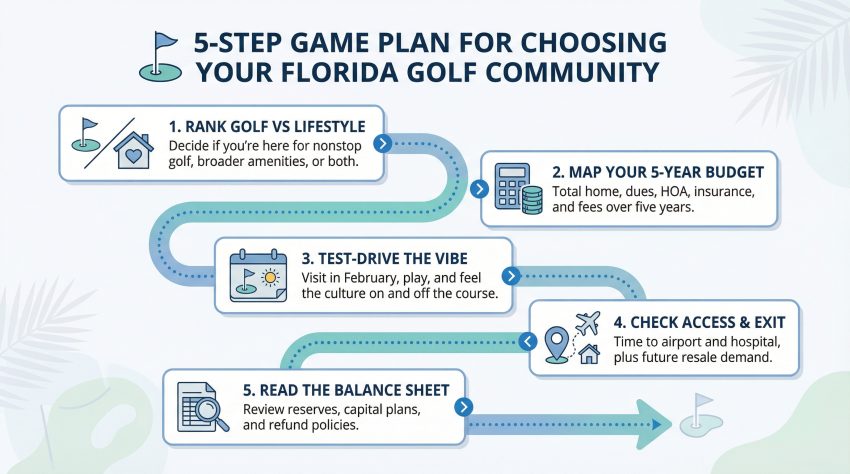
1. Rank golf against lifestyle
Ask how many rounds you truly want.
If your calendar centers on morning tee times and mid-week matches, lean toward equity clubs with tight member caps. Crave spa days, food festivals, or a neighborhood full of kids? Bundled or hybrid communities usually deliver deeper amenity menus and wider social circles.
2. Map the full five-year budget
Do not stop at the sticker price.
Add home cost, initiation or transfer fees, annual dues, HOA payments, insurance, and food minimums, then multiply by five. The math often shows that a “cheap” bundled condo with higher monthlies can match an equity villa once a future refund is considered. Spreadsheets prevent surprises.
3. Test-drive the vibe in peak season
Websites can charm, but fairways in February tell the truth.
Book a discovery stay, play a morning slot, and time the pace. Linger in the grill room. Are members welcoming or cliquish? Does the locker hallway echo with juniors in July or only soft-spiked retirees? Culture is the hardest element to shift after closing.
4. Check access and exit routes
Open Google Maps before falling for the fountain at the gate.
How long to the nearest airport? Where is the hospital? Can grandkids Uber to a beach or mall? Then flip the coin: when you sell, will a six-figure buy-in shrink your buyer pool or will a coveted waitlist lift demand? Location and liquidity march together.
5. Read the balance sheet, not just the brochure
Request reserve-fund statements, capital plans, and resignation policies. Healthy clubs keep at least a quarter of annual dues in reserve and publish clear timelines for equity refunds. If answers sound vague, treat the accounting the same way.
Work through these five checkpoints and you move from palm-tree daydreams to concrete confidence, ready to choose a Florida address that fits both your handicap and your wallet.
Quick FAQs
What exactly is a “bundled” golf community?
Buy the home, get the membership. One closing, one set of keys, and you are on the tee sheet the next morning, with no six-figure deposit or approval committee.
Does an equity club refund my deposit?
Yes, but only after a new member replaces you and according to the refund percentage in the bylaws, often 70–80 percent. Expect delays in soft markets.
I am a snowbird. Can I pay dues only for the months I am in Florida?
Private clubs bill annually. A few offer seasonal or social tiers, and bundled owners can rent out their membership when they head north, but prorated golf dues are rare.
Will living in a golf community raise my resale price?
Desirable clubs with waitlists often add a premium, but hefty buy-ins can also shrink your buyer pool. Healthy finances and fresh amenities matter as much as the logo on the flagstick.
Are there affordable options under $400K?
Yes—condos in bundled communities such as Heritage Bay, coach homes in Lakewood Ranch, and 55-plus villas in The Villages all start below that line while still giving you unlimited golf or pay-as-you-play flexibility.
Conclusion
Work through these five checkpoints and you move from palm-tree daydreams to concrete confidence, ready to choose a Florida address that fits both your handicap and your wallet.