
I used to walk through my house at night flipping switches without really looking. Lights turned on, rooms got bright, and that felt like enough. Then one evening my sister came over and asked why the bedroom felt so uncomfortable even though we’d just bought new furniture. I didn’t have an answer. The furniture was fine. The paint was fresh. But she was right. Something was off.
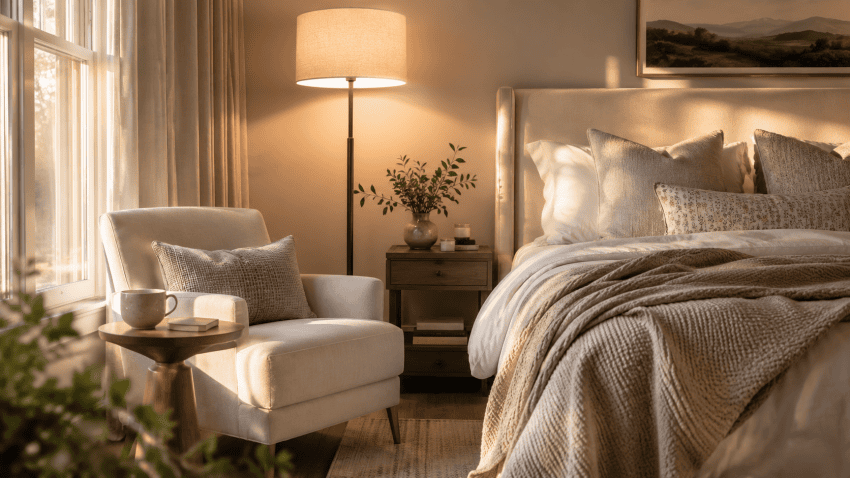
Turns out, I’d been ignoring the one thing that shapes how every room actually feels. Lighting. Not just whether it’s there, but where it comes from, how it spreads, and what it’s doing to the mood of the space. I started paying attention, and within a week I’d made three small changes that completely shifted how we used our home. The bedroom finally felt restful instead of just dim. The bathroom stopped feeling like a cold cave every morning. And the living room became the space we actually wanted to spend time in after dinner. None of it required an electrician or a big budget. Just five minutes in each room to look at what was actually happening with the light. Here’s what I check now, and what you should look for too.
Start With the Bedroom and Ask One Question
Walk in and stand in the doorway. Is there anywhere in this room you can read comfortably without squinting or turning on the overhead? If the answer is no, you’re missing task lighting, and it’s costing you more than you think.
Most bedrooms rely entirely on a ceiling fixture and maybe a small lamp on the nightstand. That works for getting dressed, but it doesn’t create the kind of flexible, layered lighting that makes a bedroom feel like a retreat. I realized this when I kept reaching for my phone at night instead of a book, not because I didn’t want to read, but because the lighting made it feel like too much effort. The overhead was too harsh, the nightstand lamp too dim, and there was nowhere in between that actually invited me to settle in with a book.
Adding a dedicated reading light changed everything. I didn’t need anything hardwired or complicated, just something that could go exactly where I needed it without taking up surface space or requiring a side table. That’s when I discovered that choosing the right floor lamps for bedroom use makes a bigger difference than I ever expected, because the height puts light at the perfect angle for reading without glare, and you can position them anywhere without being locked into where your outlets are. I picked one with an adjustable arm and a dimmer switch, and now there’s a corner in our room that feels like it was designed for winding down. The National Sleep Foundation’s 2025 study found that bedroom lighting directly affects sleep quality, with harsh overhead lighting before bed reducing melatonin production by up to 30%. Having a softer, directional option lets you ease into the evening instead of going from bright to pitch dark with nothing in between.
Check Every Bathroom Ceiling and Notice What’s Missing
Bathrooms are tricky because most of them only have one light source, and it’s almost always directly above you. Stand in front of the mirror in the morning and look at your face. Are there shadows under your eyes that aren’t really there? Dark spots under your chin? That’s not the mirror. That’s the light coming from the wrong place.
Overhead lighting in a bathroom creates shadows in all the spots you’re trying to see clearly. It’s functional enough to not feel broken, but it makes everything from putting on makeup to shaving harder than it needs to be. I didn’t realize how much this bothered me until I visited a friend’s house and her bathroom had sconces on either side of the mirror. The difference was immediate. No shadows. Just even, clear light that actually helped instead of getting in the way.
Here’s the thing most people don’t realize. You don’t need to choose between overhead lighting and task lighting. You need both, and they need to do different jobs. Side lighting at mirror height eliminates shadows and gives you the clarity you need for grooming. But the ambient layer matters just as much, because it fills the rest of the room and keeps the space from feeling dim or cramped. That’s where investing in quality bathroom ceiling lights becomes one of those upgrades that improves your morning routine in ways you didn’t expect, because the right fixture distributes light evenly across the entire space instead of creating one bright spot with dark corners everywhere else. Residential lighting trends show that layered bathroom lighting has become standard in newer home builds, with homeowners finally demanding more than a single overhead fixture. One light source isn’t enough.
If you’re not ready to add sconces, check the temperature of the bulb in your ceiling fixture. Warm white (2700K to 3000K) is gentler in the morning but can make colors look off. Daylight bulbs (5000K to 6500K) give you the most accurate color rendering, which matters when you’re getting ready for the day. Swapping the bulb takes two minutes and costs less than ten dollars, but it changes how the whole room feels. If you’re working on multiple upgrades at once, these lighting tweaks pair perfectly with other budget friendly bathroom upgrades that don’t require major renovation work but still deliver noticeable improvements.
Walk Through Your Main Living Space at Dusk
This is the test most people skip. Don’t turn on any lights. Just sit in your living room or kitchen as the sun goes down and notice when the space starts to feel uncomfortable. Where does it get dark first? What corners disappear? When do you instinctively reach for a switch?
Most homes have one or two ceiling lights in the main living areas, and people treat them like on-off switches. Bright or dark. But real comfort lives in between. I noticed our living room felt fine until about 6 PM, and then it went from pleasant to gloomy in about ten minutes. There was no middle ground. Adding one lamp on a side table and one near the bookshelf gave us three lighting levels instead of two, and suddenly the room worked at every time of day.
This isn’t about more light. It’s about control. If you can only turn everything on or leave everything off, you’re stuck with whatever the builder thought was enough. But if you can turn on one lamp for quiet reading, two for conversation, or all of them when you’re hosting, the room starts to feel like it’s actually responding to how you live. A 2026 study from the Lighting Research Center found that homes with layered living room lighting scored 40% higher in occupant satisfaction compared to homes with single-source overhead lighting. People don’t always know why a room feels better, but they notice when it does.
Look at Entryways and Hallways
These spaces get ignored because you don’t spend much time in them. But they set the tone for everything else. Walk in your front door at night and pay attention to what you see first. Is the space welcoming, or does it feel like you’re walking into a dim tunnel?
Entryway lighting should do two things. Make it easy to see what you’re doing (keys, shoes, bags), and make the space feel like it’s glad you’re home. A single overhead bulb usually handles the first part but skips the second. I added a small lamp on the console table near our door, and it completely changed the feeling of coming home. The space went from functional to warm in about thirty seconds.
Hallways are the same. If they’re only lit by whatever spills in from nearby rooms, they feel like dead space. One simple fixture or even a plug-in option changes that. You’re not trying to make them bright. You’re trying to make them intentional. When every part of your home has its own light source, the whole place feels more finished and more livable.
What About Energy Bills?
This comes up every time someone suggests adding more lighting. The assumption is that more lights means higher bills, but that’s not how it works anymore. LED bulbs use about 75% less energy than incandescent bulbs and last 25 times longer, according to the U.S. Department of Energy. Running an LED bulb for three hours a day costs about a dollar per year. Adding a few lamps around your home won’t move your electric bill in any noticeable way, especially if you’re replacing older, less efficient bulbs at the same time.
The bigger shift is that you’ll actually use your lights strategically instead of turning on every overhead fixture just to see. When you have lighting options in every room, you stop over-lighting spaces and start using exactly what you need. That’s better for your energy use and better for how the space feels.
I also switched to bulbs with lower wattage in places where I didn’t need full brightness. A 40-watt equivalent in a bedside lamp is plenty for reading, and it creates a softer, more relaxed mood than a 60 or 75-watt bulb. Same fixture, different result, just by changing what’s inside.
The Checklist I Use Now
Every few months I do a quick walkthrough with these questions in mind. It takes less than five minutes per room, and it keeps me from falling back into the habit of just ignoring how the lighting actually works.
Does every main room have at least two independent light sources? Can you adjust the brightness or mood without turning everything on or off? Are there any dark corners that make the room feel smaller or less inviting? Is the lighting helping you do what you actually do in that space, or is it just there because it was already installed?
If the answer to any of these is no, that’s where I make a change. Sometimes it’s adding a lamp. Sometimes it’s moving one from a room where it wasn’t getting used. Sometimes it’s just swapping a bulb for a different color temperature. Small fixes, but they add up to a home that feels significantly more comfortable and more like yours.
When to Call It Done
You’ll know the lighting is working when you stop noticing it. That sounds backwards, but it’s true. Good lighting doesn’t announce itself. It just makes everything easier. You read without adjusting your position. You cook without leaning over the counter to see what you’re chopping. You walk into your bedroom at the end of the day, and it actually feels like a place to unwind.
I’m not suggesting you need to light every corner or fill your home with fixtures. Just make sure the rooms you use most have options. That’s what changes a house from a place where the lights work to a home where the lighting works for you. If you’re unsure where to start, focus on the bedroom first. That’s where you begin and end every day, and it’s where better lighting makes the most immediate difference. From there, the bathroom, then the living areas. Five minutes per room. That’s it. You’ll see what’s missing, and you’ll know exactly how to fix it.
Frequently Asked Questions
How many light sources does a bedroom actually need?
Three is the ideal number. One overhead for general brightness, one near the bed for reading or winding down, and one accent or task light in a corner or closet area. This gives you flexibility for different activities and times of day. More than three can start to feel cluttered unless the room is quite large.
What’s the best color temperature for bathroom lighting?
Daylight bulbs in the 5000K to 6500K range give the most accurate color, which is helpful for grooming tasks. If that feels too harsh or clinical, you can use 4000K as a middle ground. Avoid warm white (2700K) in bathrooms unless it’s paired with a brighter overhead fixture, as it can make the space feel dim and make colors look off.
Can I use smart bulbs to adjust lighting without adding new fixtures?
Absolutely. Smart bulbs let you control brightness and color temperature from your phone or voice assistant, which gives you layered lighting control without changing the fixture itself. They’re particularly useful in rooms where you can’t easily add more lamps or where you want to adjust the mood without getting up. Just make sure the bulbs are compatible with your existing fixtures and that you have reliable Wi-Fi coverage in that part of your home.
Is it worth replacing old fixtures, or should I just change the bulbs?
Start with the bulbs. Swapping to LED and adjusting color temperature can make a dramatic difference without any installation. If the fixture itself is damaged, outdated, or poorly positioned, then replacement makes sense. But in most cases, the bulb is doing 80% of the work, and that’s where you’ll see the fastest improvement for the lowest cost.