
A television can become the focal point of a living room, especially when open shelves, exposed equipment and visible cables draw attention to the screen. Creating balance means choosing what belongs behind closed doors and leaving display space for books, photographs and decorative objects. These five considerations can help organize a TV wall while keeping the room comfortable and useful beyond watching television.
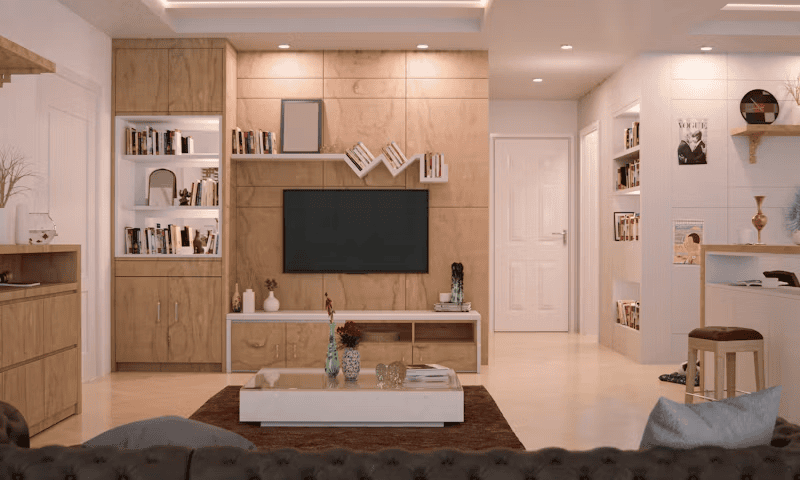
1. Sort What Actually Needs to Be Hidden
Not every electronic device needs concealment. The first consideration is how much heat the equipment generates, since some components can sit inside closed storage while others require ventilation.
The Martha Stewart Living Room Collection is a modular storage system from Flash Furniture, available in the Bedford and Lily Pond lines, that combines cabinets, hutches, and TV stands into a custom built-in look with solid wood frames, soft-close doors, and adjustable shelving. The two fluted wood cabinets in the Bedford 6-Piece Modular Media Center provide the configuration’s genuinely concealed storage, using opaque fluted-wood doors with soft-close hinges.
Devices that run cool, a streaming stick, a cable box, a router, a soundbar remote, sit fine behind closed cabinet doors. Game consoles under load and AV receivers generate real heat and need either a vented cabinet or an added fan; BDI’s Corridor line and AC Infinity’s cabinet fans are built for that case. For everything else, the Martha Stewart Bedford pieces keep components behind soft-close doors, with rear cord management openings for routing.
In this six-piece configuration, only the two fluted wood cabinets conceal their contents. The rear cord management openings are on the open hutches, and the glass-door cabinets keep items enclosed but visible. Placement behind closed doors still depends on each device’s ventilation and clearance requirements. A closed cabinet should never replace the ventilation required by a heat-generating device.
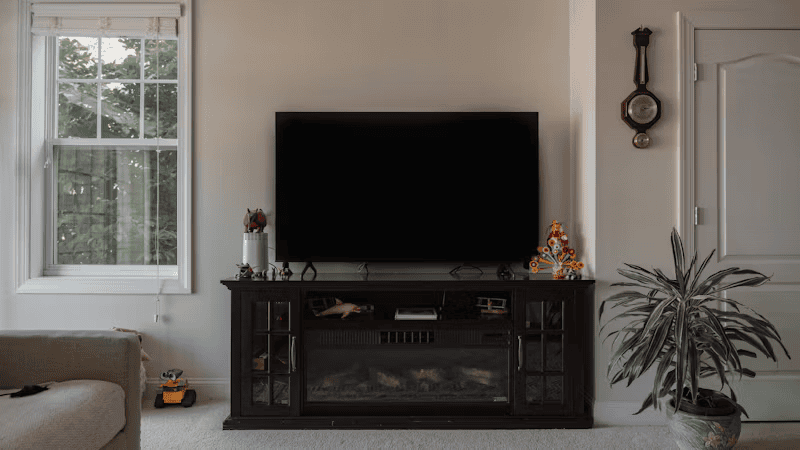
2. Choose Closed Storage Over Open Shelving
Closed doors are what actually keep everyday clutter out of view. Open shelves organize belongings, but everything stored there remains visible. The Bedford 6-Piece Modular Media Center illustrates how different storage types can work together. Its two opaque fluted-wood cabinets conceal their contents behind soft-close doors, making them useful for items that would otherwise create visual clutter.
The glass-door cabinets serve another purpose. They keep belongings enclosed but visible, and the open hutches provide display space. Neither should be mistaken for concealed storage.
Closed cabinet storage rather than open shelving keeps less attractive items out of view, leaving display areas for books, framed photographs and decorative objects. Furniture that keeps cable boxes, streaming devices, and gaming consoles behind closed doors must provide the ventilation each device requires.
The same principle applies beyond the television wall. Using concealed storage solutions for items that don’t need to remain visible helps keep the wider living room organized. Display shelves can then hold a smaller selection of objects without making every available surface feel crowded.
3. Let the Wall Read as Furniture, Not a Media Rack
The BDI Corridor 8175 has an advantage in its airflow-oriented design, with slatted doors and fixed shelves, at around $3,299. The BDI Corridor 8179, at around $4,399, offers louvered walnut doors and adjustable shelves, providing another furniture-led approach to media storage.
Both illustrate how door treatments, shelving, and materials influence the appearance of entertainment furniture. Their specifications also demonstrate why the furniture surrounding a television deserves as much consideration as the screen itself.
At around $2,890, the Bedford 6-Piece Modular Media Center in White and Gold forms a six-piece coordinated wall of two fluted wood cabinets, two glass-door cabinets with soft-close hinges and two open hutches. Measuring 79.25 inches high, 126 inches wide and 16.75 inches deep, the configuration includes adjustable interior shelves and costs less than both named Corridor models. Its coordinated finish brings closed storage and display areas together as living room furniture.
The Parker House Catalina 7-Piece modular entertainment wall offers another format, with a cottage white finish and a price around $1,573. Its seven-piece arrangement provides a different visual treatment and configuration.
The goal is storage that reads as living room furniture, not as a media rack. Coordinated finishes, consistent proportions, and a balance of closed and display storage help achieve that effect. Surrounding furniture matters too. Sofas, side tables, artwork, and lighting should contribute to the room’s appearance so the television wall doesn’t dominate the entire space.
4. Handle the Cords
Cord clutter usually comes from poor routing rather than the devices themselves. Even neatly arranged equipment can look disorganized when cables hang behind shelves or trail across visible surfaces.
The Bedford 6-Piece Modular Media Center has rear cord management openings on its open hutches. These provide a route for cables connected to equipment placed in those sections, helping keep wiring from dominating the arrangement.
Planning should begin with the location of the television, outlets, and connected devices. Cables can then be routed toward their connection points without unnecessary lengths remaining exposed.
Furniture openings are one approach, while hiding TV cords in the wall is a separate DIY option for homeowners willing to make wall modifications. That approach requires additional work, whereas suitable furniture routing can address the problem without cutting into walls. Keeping power cables accessible and avoiding tightly packed wiring also makes equipment easier to inspect or rearrange.
5. Leave Room to Change
A modular system can adapt as storage needs change, preventing a television wall from becoming one fixed arrangement that no longer suits the household. The Martha Stewart Living Room Collection includes Bedford and Lily Pond designs, with 2-piece through 6-piece configurations that allow coordinated arrangements to develop over time. A smaller setup can become a broader wall composition as compatible pieces are introduced.
The collection is manufactured by Flash Furniture, a Ubique Group company, and uses solid wood frames, bases, and legs, with engineered wood used for wood door panels and shelving. Across Bedford and Lily Pond, six curated finishes offer options for coordinating storage with existing furniture. This creates a system that expands rather than a purchase you replace. Modular storage that looks like custom built-ins can provide visual continuity without permanent cabinetry.
Expansion should also account for stability. Following furniture anchoring and tip-over safety recommendations is important when arranging taller cabinets and other large furniture. The pieces require adult assembly and ship in multiple boxes. For the built-in appearance, the promise is no renovation, no contractor, no DIY project: no construction, cutting, trim, or painting is needed to create the coordinated look.
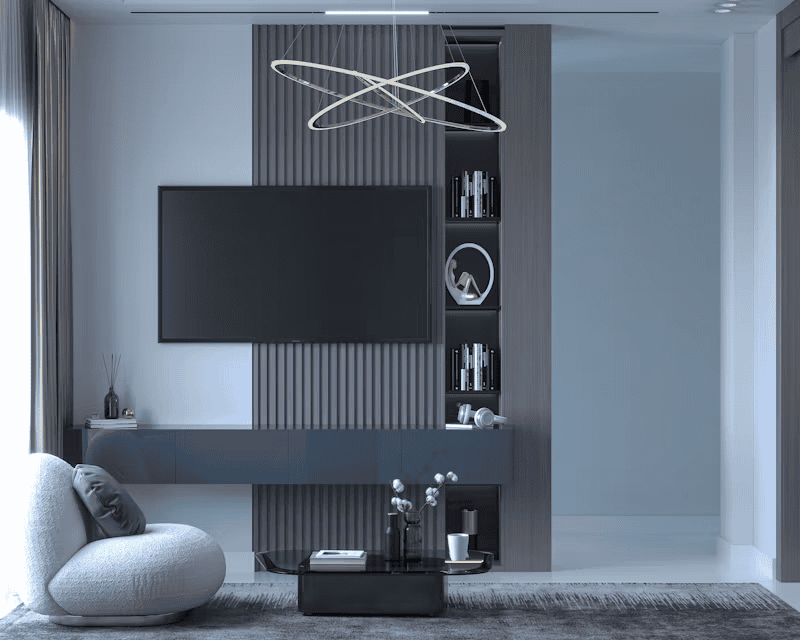
A Living Room That Works Beyond the Screen
A balanced TV wall doesn’t require every device to disappear. It depends on choosing what belongs behind closed doors, what stays on display, and how the furniture can change with the household.
Across Bedford and Lily Pond, six curated finishes help create modular storage that looks like custom built-ins. The collection is manufactured by Flash Furniture, with solid wood frames, bases, and legs, and soft-close doors and adjustable shelving.
Its 2-piece through 6-piece configurations support a coordinated wall without replacing every piece as needs change. The result is no renovation, no contractor, no DIY project to achieve a more unified living room.
Frequently Asked Questions
Do I Need a Vented Cabinet for a Gaming Console or Streaming Device?
It depends on the equipment. Lower-heat devices may work inside closed storage if their manufacturers permit it. Gaming consoles under load and AV receivers generate more heat and need adequate ventilation, whether through a vented cabinet or a suitable fan. Always follow the equipment manufacturer’s clearance requirements.
What’s the Difference Between Storage That Hides Things and Storage That Just Organizes Them?
Opaque cabinet doors conceal their contents. Glass doors and open shelves organize belongings but leave them visible. Combining both allows everyday clutter to remain out of sight while decorative objects contribute to the room.
How Do I Keep a TV Wall From Feeling Like a Dedicated Media Room?
A mix of closed storage and a few display areas helps balance the wall, while concealed cable runs and coordinated finishes keep the arrangement visually cohesive. Books, artwork, and decorative objects also help the television feel like one element of the living room.
Can I Start With a Smaller Storage Setup and Add to It Later?
Yes, provided the furniture belongs to a modular system with compatible pieces. A smaller configuration can expand into a larger arrangement without replacing the original furniture. Dimensions, finishes and compatibility determine which units can be added to the existing arrangement.